environment • Saturday, April 11, 2026
Stargazing with Peace of Mind: What NASA’s Asteroid Nudge Means for Olympia
NASA successfully moved an asteroid, proving we can defend the planet. Here’s why this cosmic win matters to our community in the South Sound.
### A Giant Leap for Planetary Defense (and Local Peace of Mind)
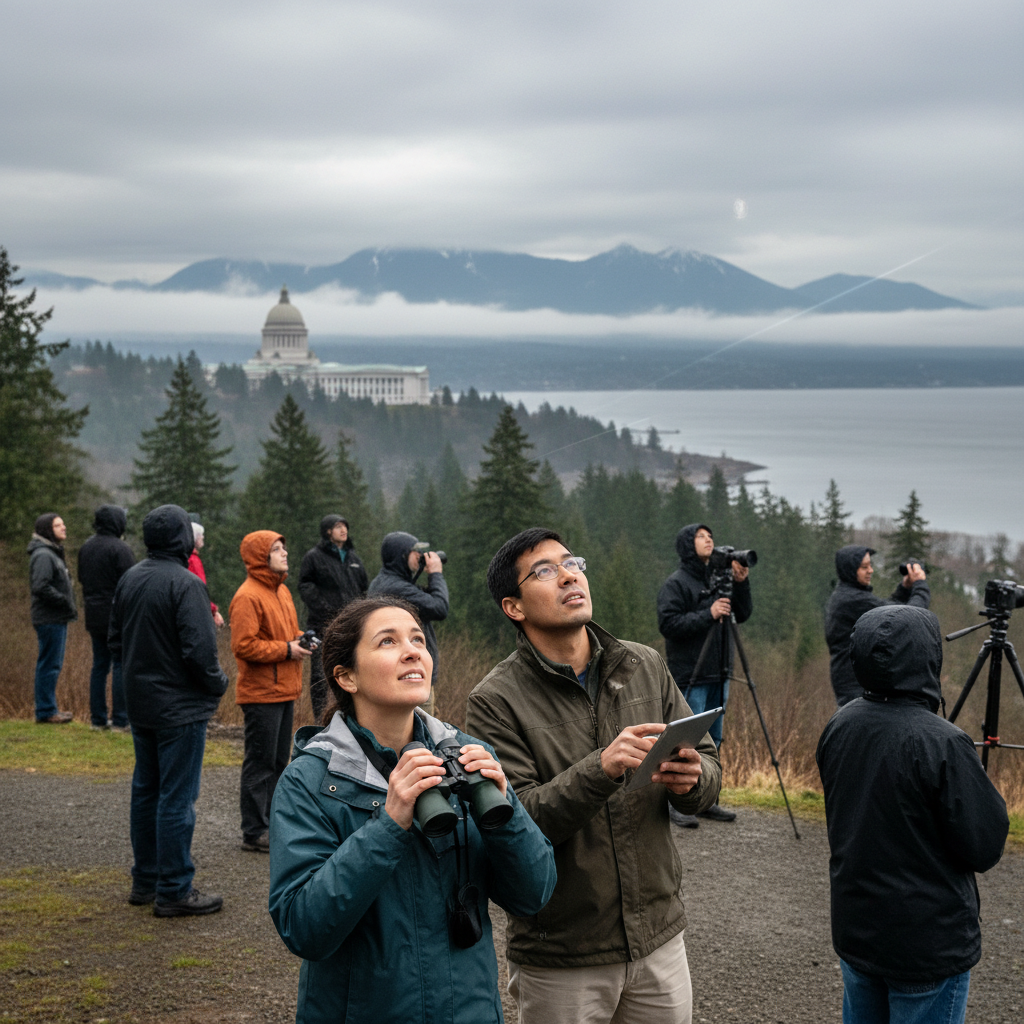
Most of us in Olympia are used to looking at the sky for two reasons: checking if we need an umbrella for a walk around Capitol Lake, or hoping the clouds part long enough to catch a glimpse of Mt. Rainier. But recently, the scientific community gave us a reason to look much further up—and with a new sense of security.
As reported by *The Columbian*, NASA’s Double Asteroid Redirection Test (DART) successfully slammed a spacecraft into the asteroid Dimorphos. This wasn't a scene from a Michael Bay movie; it was a calibrated, high-stakes physics experiment designed to see if we could physically nudge a space rock off its path. The result? A resounding success.
### Why This Isn’t Just “Space Junk” News
When we talk about “existential threats” in Thurston County, we’re usually discussing the Cascadia Subduction Zone or the rising sea levels threatening downtown Olympia’s historic district. It’s easy to dismiss a celestial collision as something for the scientists at the University of Washington or the folks at NASA to worry about.
However, there is a distinct psychological comfort in knowing that humanity has graduated from being “sitting ducks” to active participants in our own survival. In a time where local headlines are often dominated by the grit of urban living—homelessness, the legislative session, or the constant construction on I-5—this mission is a reminder that we are capable of solving massive, complex problems through science and cooperation.
### The South Sound Perspective
Olympia has always been a hub for forward-thinking and environmental stewardship. We take pride in protecting our local ecosystems, from the Deschutes River to the Puget Sound. Expanding that stewardship to our “planetary ecosystem” is a natural extension of our values.
While a direct hit on Washington State is statistically improbable, the infrastructure of our modern lives—GPS, telecommunications, and weather tracking—depends on orbital safety. The technologies born from missions like DART eventually trickles down into the tech hubs of the Pacific Northwest, fueling the innovation economy that many Thurston County residents commute to every day.
### Why This Matters Locally
* **Science Education:** For students at Evergreen State College and our local high schools, this is a “gold star” moment for STEM education. It proves that the math learned in a West Olympia classroom has real-world (and out-of-this-world) applications. * **Collective Security:** We spend a lot of time on local emergency preparedness. It’s reassuring to know there is a “global” level of emergency management looking out for us at the highest possible altitude. * **A Shift in Perspective:** Sometimes we get bogged down in the minutiae of city council meetings or neighborhood disputes. A story like this serves as a healthy reminder that we are all residents of a very small, very precious “blue marble.”
### Looking Ahead
The success of the DART mission doesn't mean we should stop worrying about our local issues, but it does mean we can check one very large worry off the list. It’s a win for human ingenuity that resonates even here in the quiet, mossy corners of the South Sound.
Next time the clouds break over the Salish Sea and reveals the stars, take a look up. It’s a little bit safer out there today than it was yesterday.
***
**OlyTimes Readers:** *Does knowing we have a 'planetary defense system' change how you think about our future, or do you find it hard to care about cosmic threats when there are potholes to be fixed on Harrison Ave? Let us know in the comments!*
Tags: NASA, Science, Space, Olympia, Thurston County